
BEFORE YOUR BUY: How to Choose the Right Rug Size for Your Room
Introduction: The Most Common Rug Mistake I See
You can choose the perfect rug—the right color, pattern, and texture—and still have it make your entire room feel unfinished if it's the wrong size.
When I'm selecting a rug for a space, I don't start by asking which color or pattern I like best. The right rug should feel intentional in relation to both the furniture and the architecture of the room.
Step 1: Start With Your Furniture Layout, Not the Room Size Alone
Two rooms with the exact same dimensions can require completely different rug sizes depending on the furniture layout. This list shares some of the most common things to take note of before you buy a rug:
Furniture placement
Sofa or sectional size
Number of seating pieces
Open versus enclosed floor plan
Location of doors and walkways
Designer perspective:
This is why I always recommend creating your furniture plan before choosing a rug. Your rug should support the furniture arrangement—not force you to rearrange the room around a rug you already purchased.
If you haven’t seen my previous post, “How to Create a Furniture Plan Before You Buy Anything.”, it walks you through determining where your furniture should go—and, in turn, what size rug makes the most sense.
Step 2: Understand What the Rug Is Supposed to Do
Before choosing a size, decide what role the rug is playing.
Is it supposed to:
Define a conversation area?
Anchor an open-concept living space?
Add softness under a bed?
Protect the floor beneath a dining table?
Visually separate one zone from another?
For example:
In an open floor plan, a rug can act almost like an invisible wall, visually defining where the living room ends and the dining area begins.
Step 3: How to Choose the Right Living Room Rug Size
Option 1: All Furniture Legs on the Rug
This works particularly well in:
Large living rooms
Formal seating areas
Open floor plans
Rooms with floating furniture arrangements
In this application, the rug should be large enough to comfortably fit all of the furniture under it. In most cases, this will require a larger rug. Look at the example below. This is one of my favorite applications because it creates a cohesive, inviting seating area.
The example shows a 12x15 rug in a large living room setting. As you can see, the sitting area feels cohesive and inviting
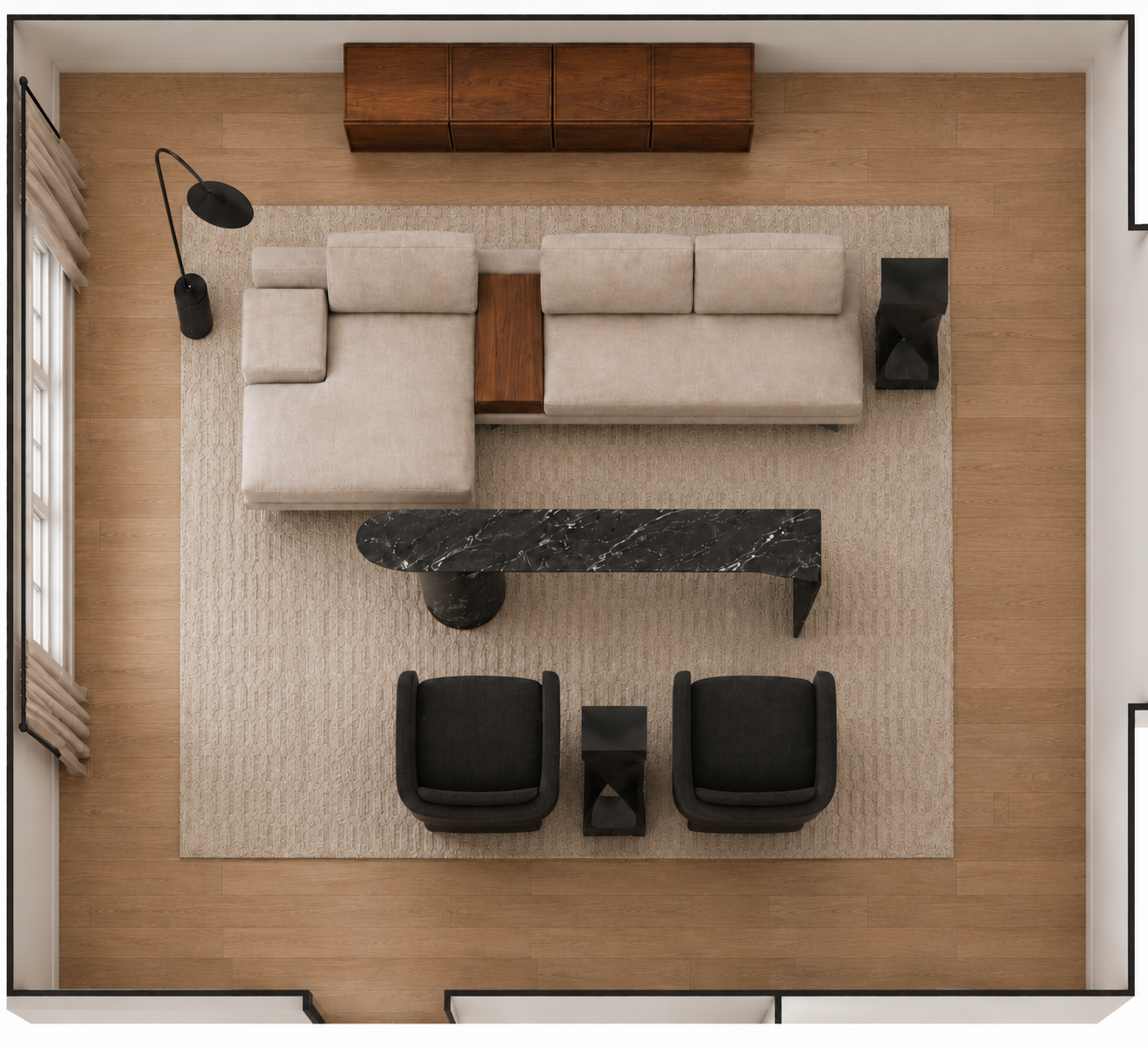
This image shows a digital rendering of one of my living room designs from above.
Option 2: Front Legs on the Rug
Probably the most practical arrangement for many average-sized living rooms. It usually doesn’t require getting into larger, more expensive rug sizes.
The front legs of:
Sofa
Accent chairs
Other major seating
should rest on the rug.
This helps visually connect the furniture pieces and makes the seating arrangement feel like one intentional group rather than several unrelated objects floating around the room.
Similar to the first option, this option brings connection and makes the design feel more finished.
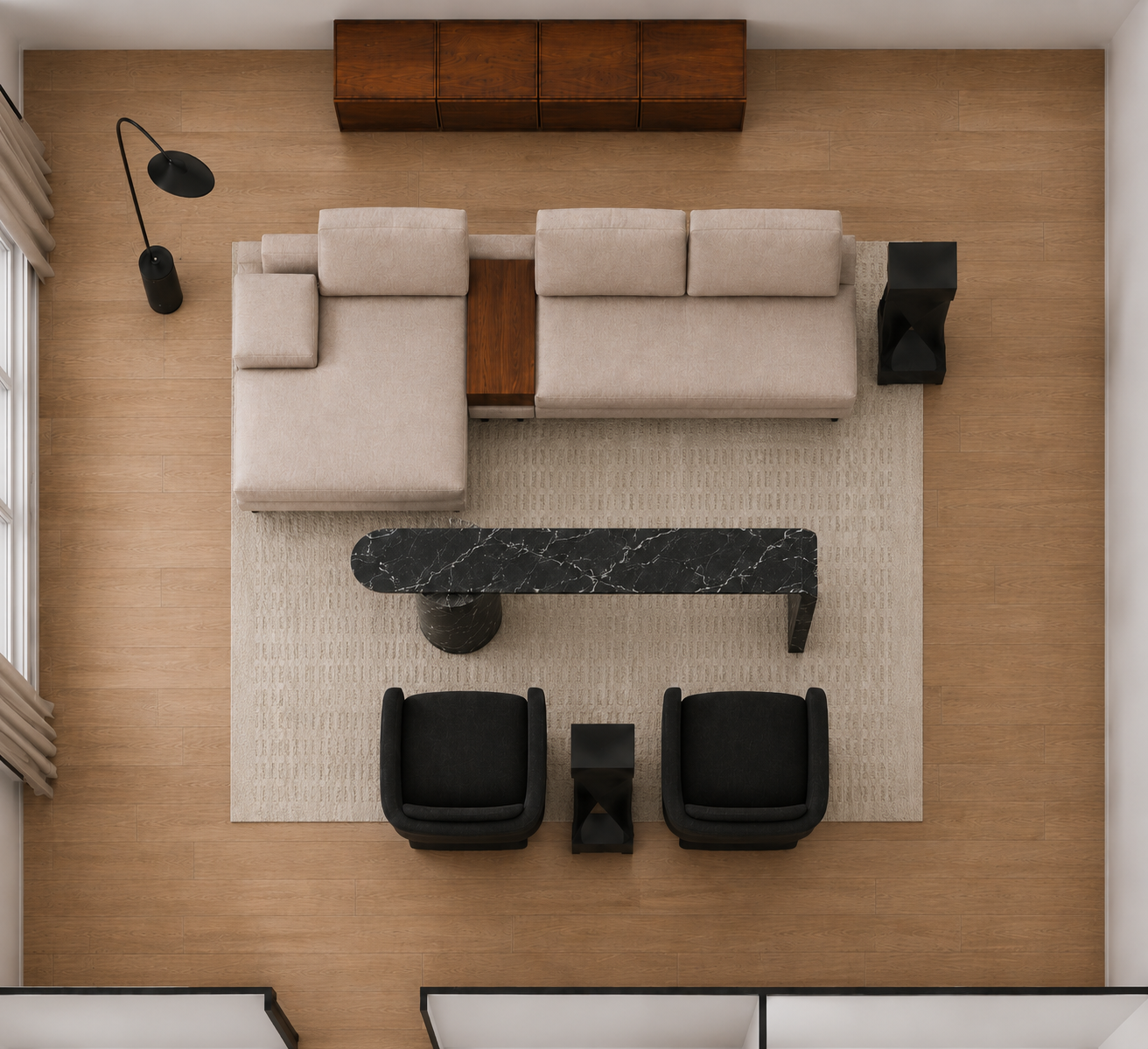
This image shows a digital rendering of one of my living room designs from above.
Option 3: The Rug Floats in the Center
This is the arrangement to be most cautious with.
A small rug floating beneath only the coffee table can make the entire room feel smaller and disconnected. I have intentionally chosen a round rug for this example as they work lovely in certain scenarios and I have seen people be tempted to use them in scenarios similar to this one.
There are exceptions, particularly in very small rooms or with intentionally layered rugs, but in most standard living rooms, I prefer a rug large enough to connect at least the front legs of the major furniture pieces.
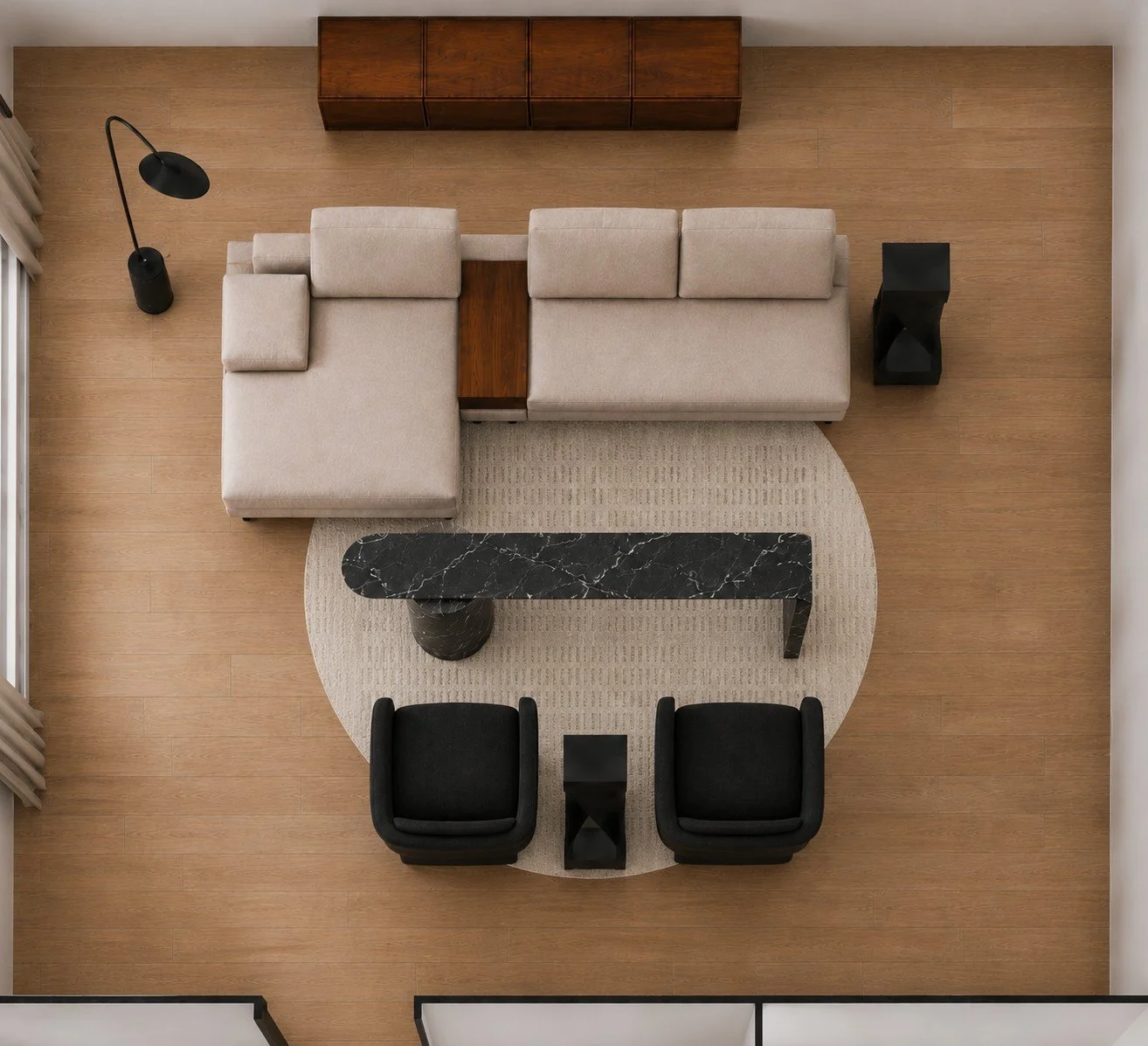
This image shows a digital rendering of one of my living room designs from above.
**Please keep in mind, these are just directions to help guide you to create a space that feels most like home to you.
Step 4: Common Living Room Rug Sizes
5' × 7' or 5' × 8': Usually best for small seating arrangements or very compact rooms.
6' × 9': Can work for smaller living rooms.
8' × 10': One of the most versatile sizes for average living rooms.
9' × 12': Often works well for larger furniture arrangements.
10' × 14' and larger: Appropriate for expansive rooms and large-scale seating groups.
These are starting points—not universal rules. The dimensions and arrangement of your actual furniture should ultimately determine your rug size.
Step 5: How to Choose the Right Dining Room Rug Size
This section does have one rule that I do like to always follow when possible:
The dining chairs should remain on the rug when they're pulled out from the table.
If your dining rug is too small, you may run into the following issues:
Chairs catching on the rug's edge
Uneven chair legs
An awkward dining experience
A visually undersized foundation for the table
Let’s take a look at some examples:
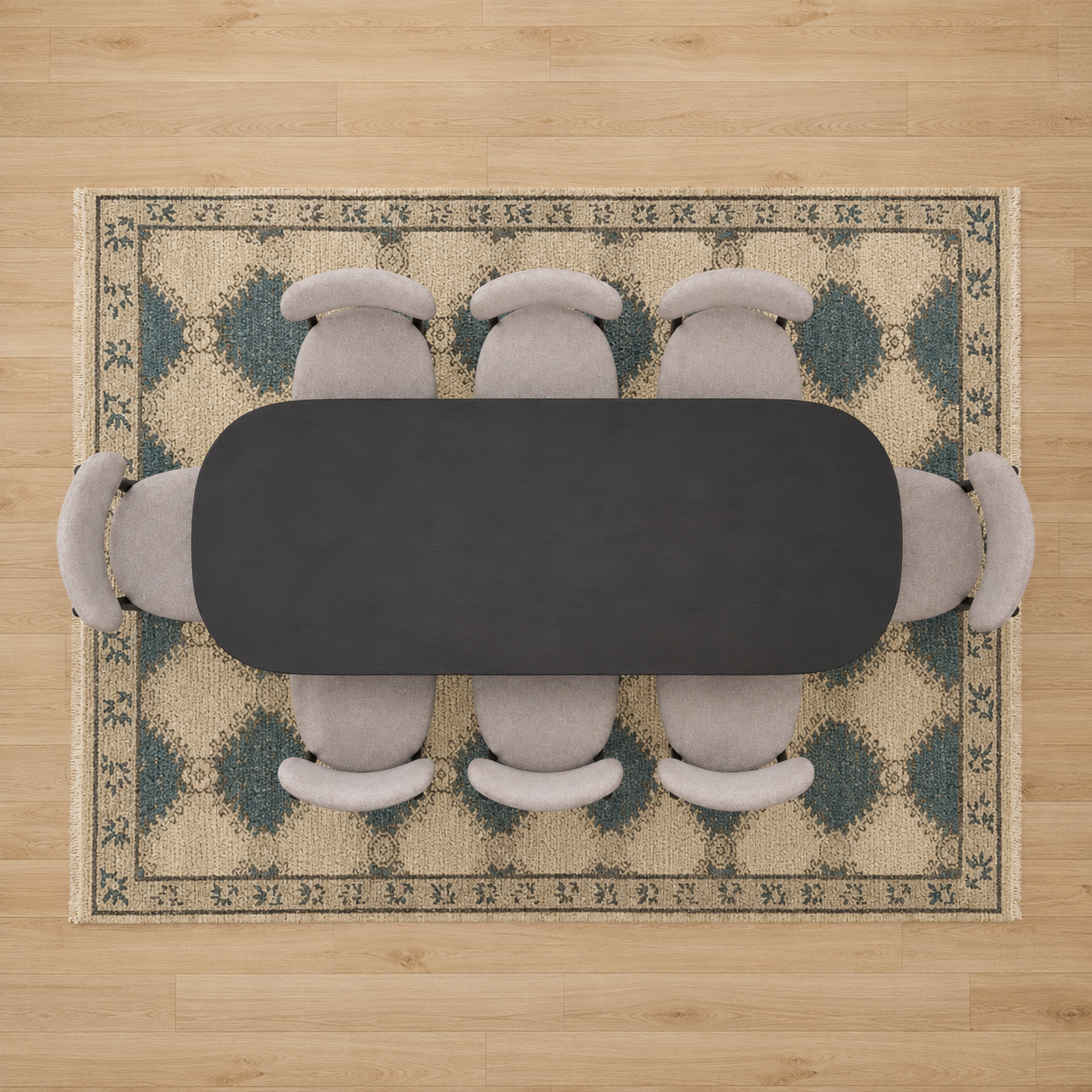
This image shows a digital rendering of one of my dining room designs from above.
The first example shown is not a bad look. You can easily see the rug pattern under the chairs and it has a nice pattern (although that’s not exactly what we are discussing in today’s post). The main issue with the size of this rug is the width does not allow the end chairs to scoot back fully. Truly, you could get away with this rug and have a perfectly functional dining experience. The end chairs are able to move about halfway and every other seat can fully extend back. If we were doing a “good better best” Scale, this would probably fall at “better” It is a great option, but there is something better.
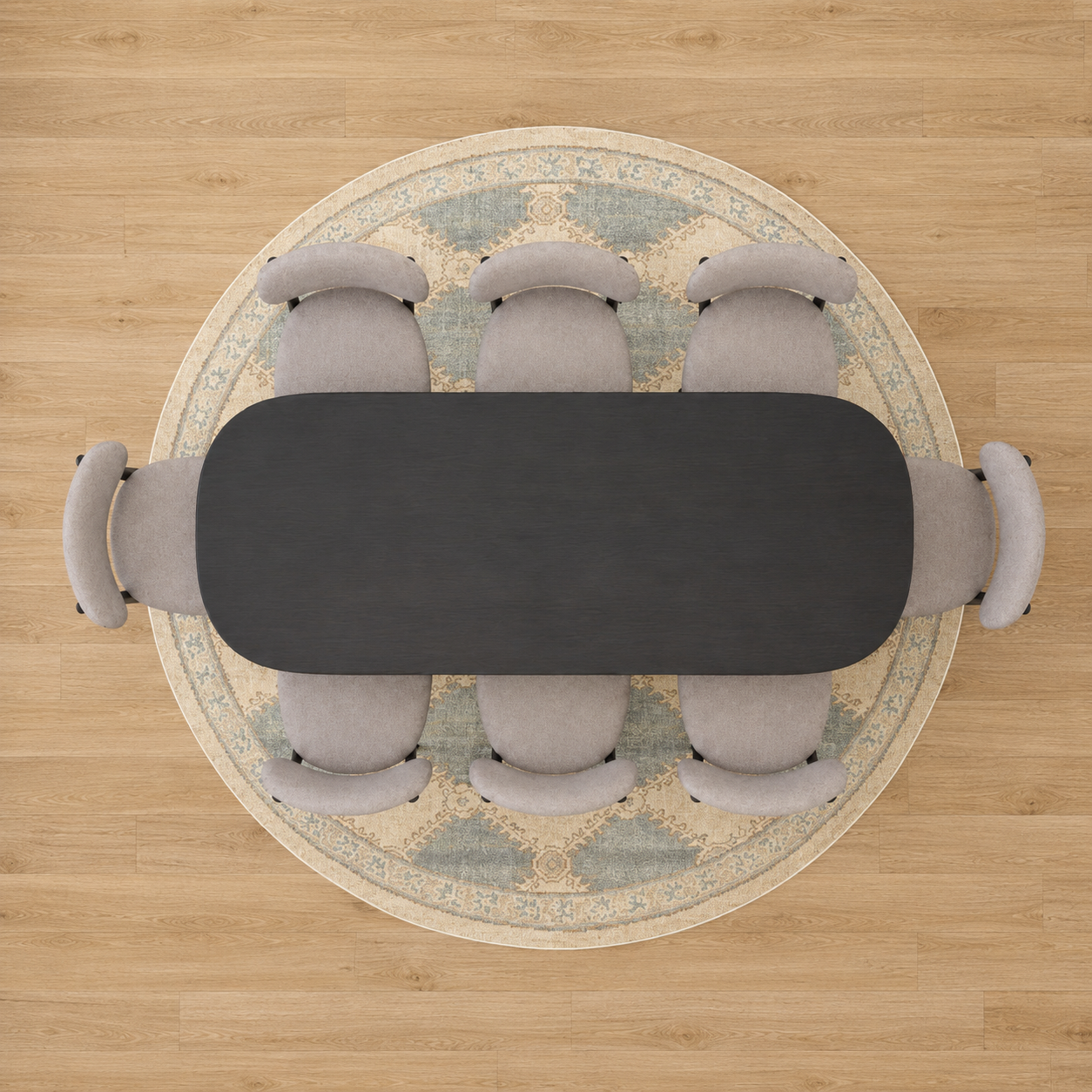
This image shows a digital rendering of one of my dining room designs from above.
The second example is probably not something I would put in a “good better best” at all. For the shape of the room and the shape of the table, I would prefer to see either a rectangular rug or an elongated elliptical shape. Something that mimics the overall shape of the furniture on top. My reason for this is not a symmetrical look, although that does make for a nice design in some cases. Instead, It is so that each chair as equal or almost equal space to back up. In the example above, the end chairs and the first and last chairs on the long parts of the table are likely to pull back to where all 4 chair legs aren’t on the same surface. This will create uneven, wobbly chairs that no one enjoys.
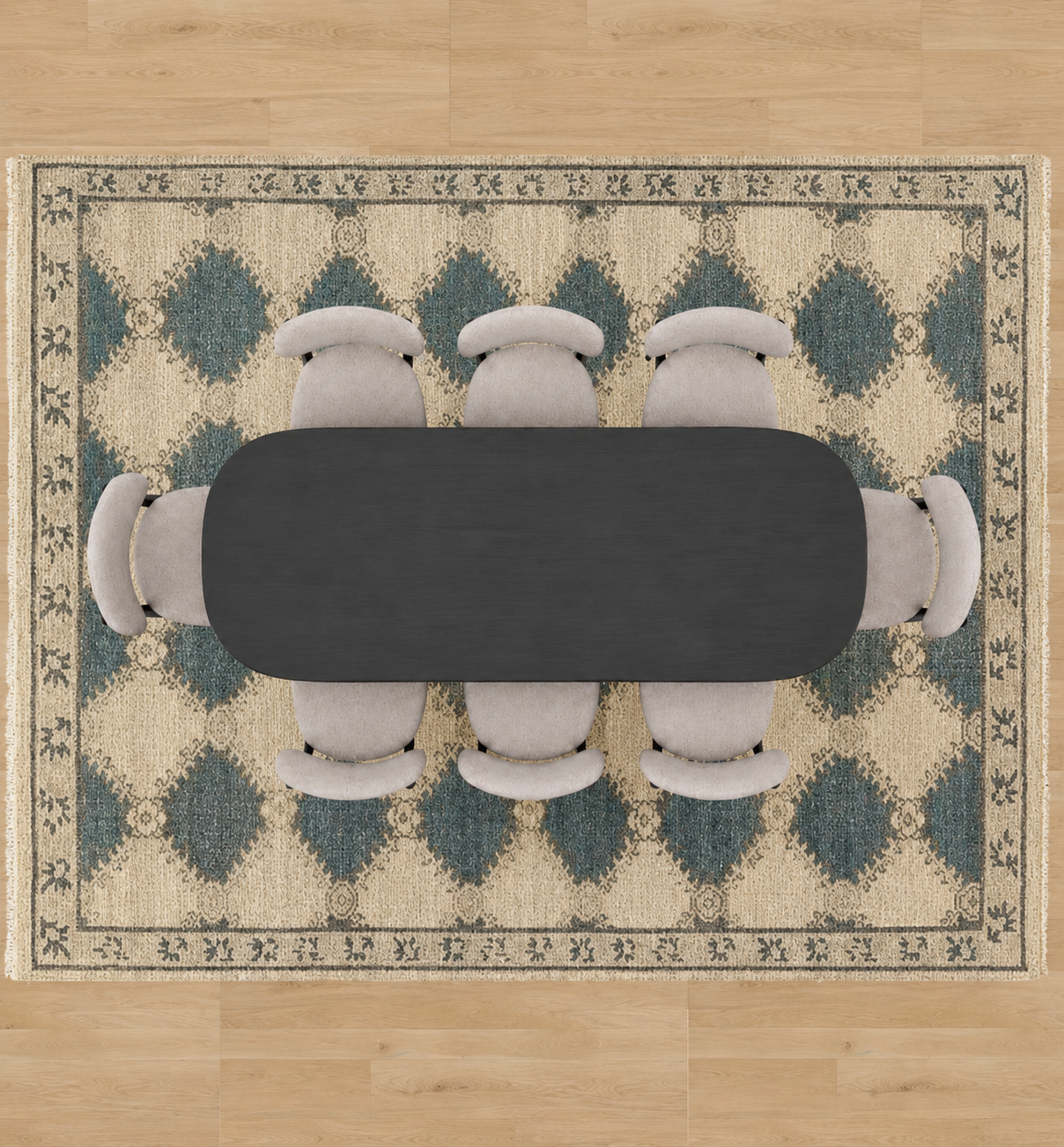
This image shows a digital rendering of one of my dining room designs from above.
Lastly, and my favorite, we have a rug that stretches at least 24’’ past every chair in its fully extended position. This allows for everyone to comfortably sit and move around comfortably without ever ending up with uneven chair legs. Notice also, how when the rug extends past the furniture further (especially in a setting where there is a large table), you are able to view more of the rug and appreciate its pattern.
Quick Tip:
Don't measure only the table. Pull out a dining chair as though someone were getting up from the table, then measure the total footprint. That's the space your rug actually needs to accommodate.
Step 6: How to Choose the Right Bedroom Rug Size
Option 1: Rug Under the Entire Bed and Extending Far Beyond Both Sides
A luxurious, expansive look that typically requires a larger rug. There are several advantages to this look, but it is not going to be the most practical for everyone.
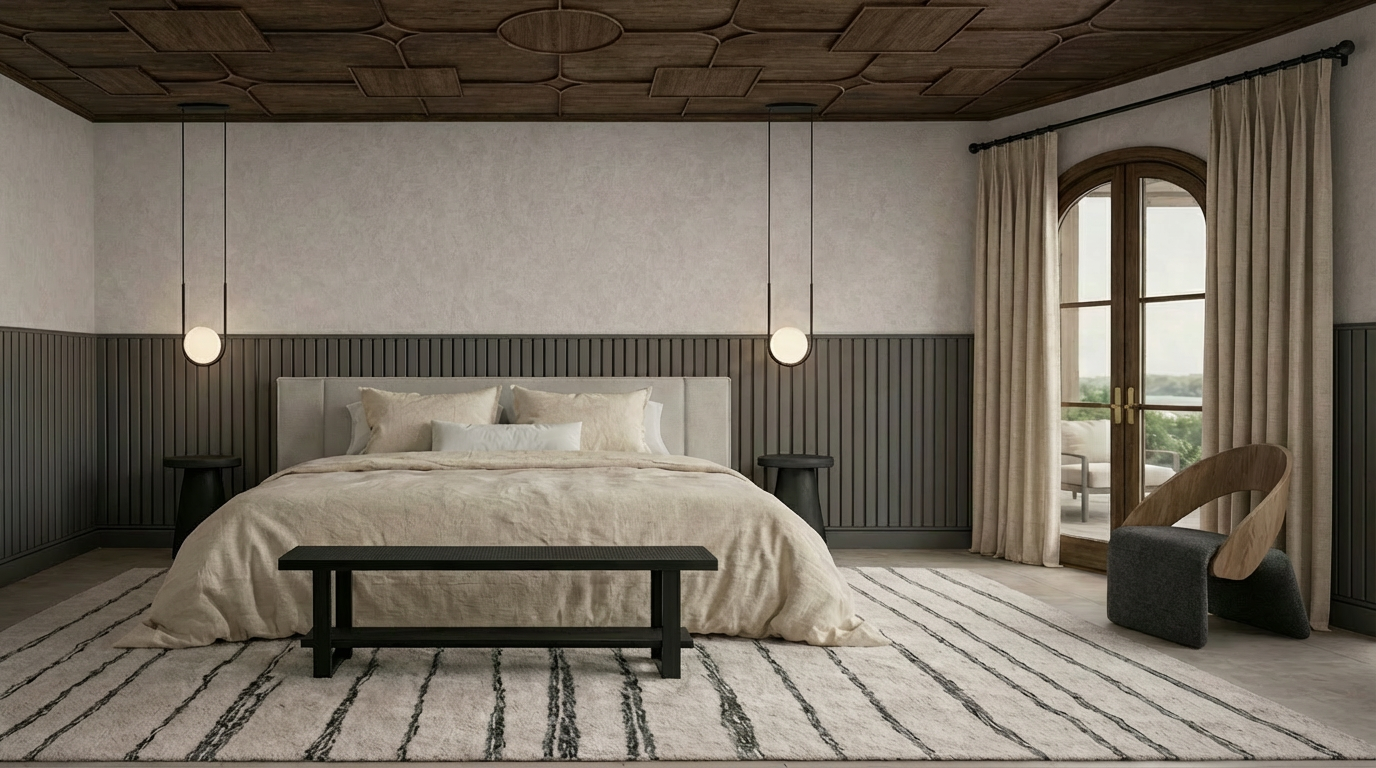
This image shows a digital rendering of one of my bedroom designs.
Like in many of our other examples, it pulls the rug pattern/ texture out further so the design can be truly appreciated and incorporated into the feel of the room.
When you step out of bed you are stepping onto a soft surface rather than a hard, cold surface. This provides a much more comfortable and luxurious experience.
I originally created this rendering for Instagram because it perfectly demonstrates how a larger rug can transform a bedroom. I love this rug because it provides a dramatic effect because of the large scale pattern, but it is still a neutral; we will talk more about rug patterns and colors in another post. What I love about the scale of this rug is how it allows for maximum floor coverage while still allowing the natural floor to show through on all sides. If there are people on both sides of the bed, this application allows both of them to step onto a soft surface when they get up.
This layout works best in larger bedrooms where there is enough space on either side of the bed to extend far past both sides. If your room does not allow for this layout, the next one is going to be the best for you.
Option 2: Rug Starts in Front of the Nightstands and Extends Slightly
The rug runs beneath approximately the lower two-thirds of the bed and extends beyond the foot and sides.
This can be a more practical option because you're not paying for a large portion of rug that's completely hidden beneath the head of the bed and your room does not have to be large enough to support the first option. This is the most common layout I use.
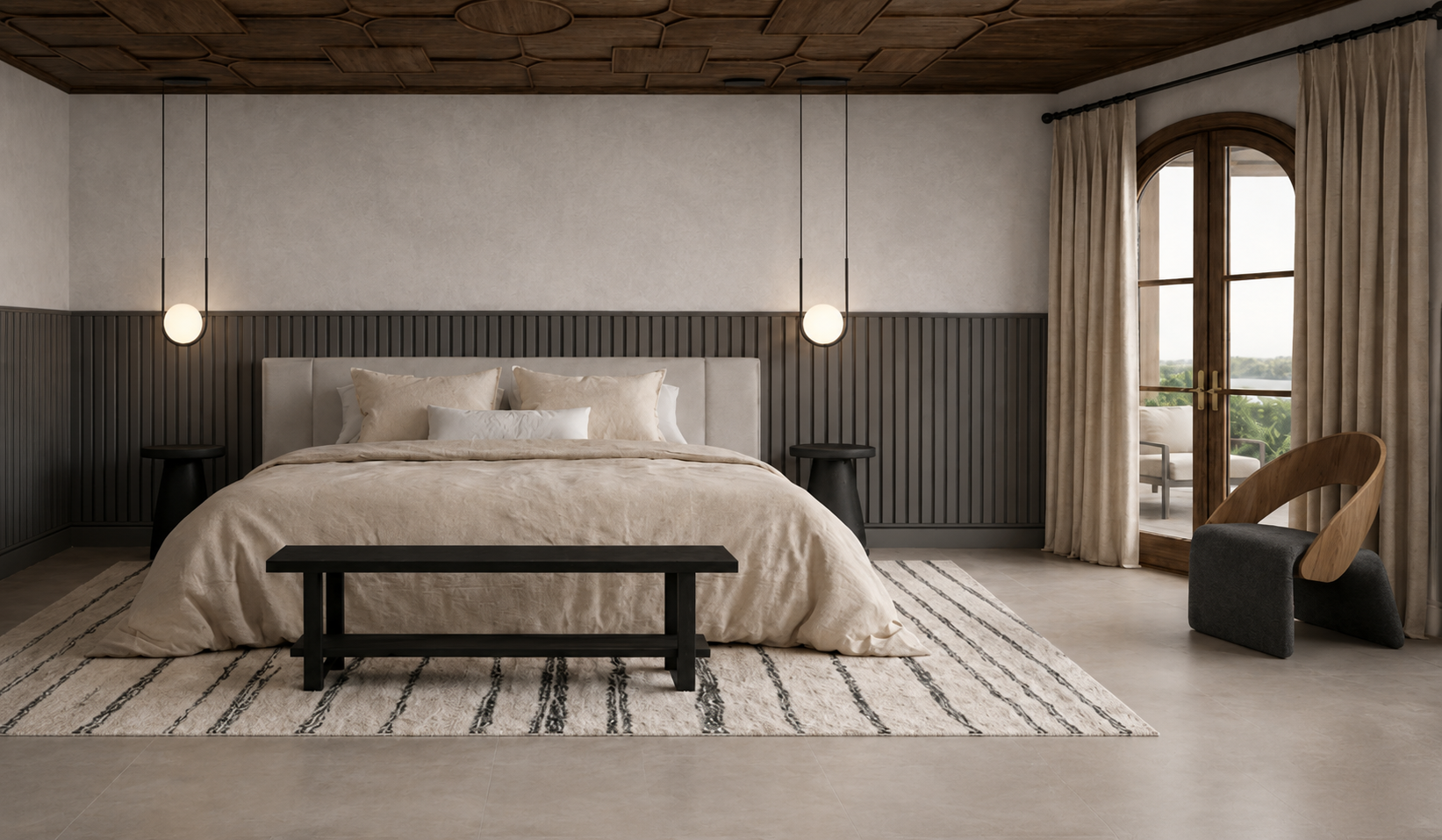
This image shows a digital rendering of one of my bedroom designs.
This layout also allows you to appreciate the pattern of the rug, but the design would also allow for a much smaller room.
An Example of What to Avoid:
I find that it is usually not worth putting a rug under the bed when the rug has to be so small that it cannot extend at all on either side of the bed. This keeps you from really appreciating the pattern or texture in the rug and it doesn’t allow you to enjoy the plushness under your feet when you wake.
In cases where a very small rug is all that can be accommodated whether for space or budget reasons, I would recommend using a small area rug or runner that starts in front of the bed. You won't enjoy the soft landing when you get out of bed, but you'll still introduce color and texture into the room.
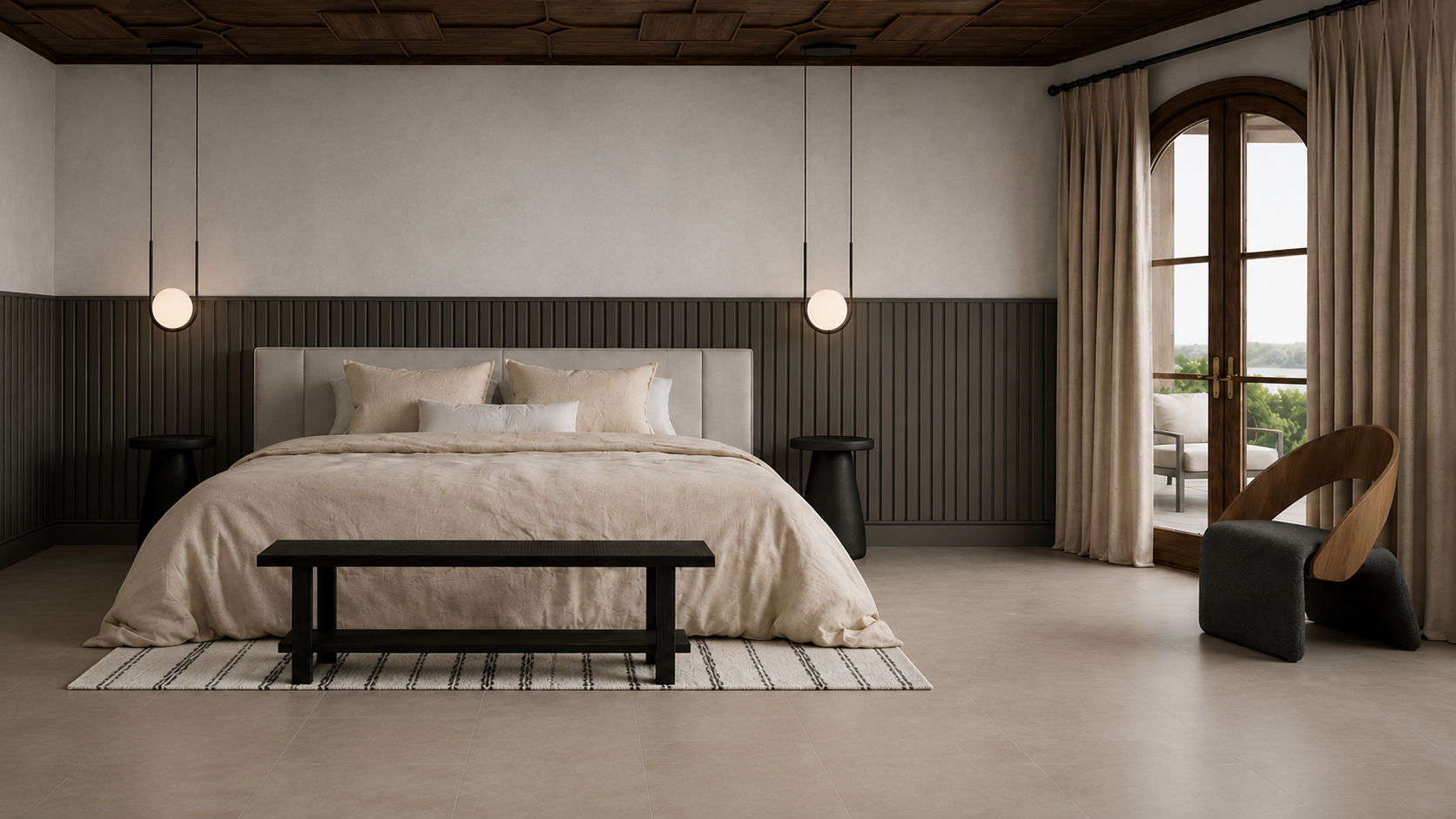
This image shows a digital rendering of one of my dining room designs. Rugs have been digitally altered and may vary slightly in the original rendering to display different outcomes.
Common Sizing Starting Points:
Queen bed: Often 8' × 10' or 9' × 12', depending on placement.
King bed: Often 9' × 12' or larger. The first example I showed is a 12’ x 15’ and the second is a 9’ x 12’. The example of what not to do is a 6’ x 9’
Furniture placement and dimensions should ultimately determine the final decision of your rug size and placement.
Step 7: Don't Forget About the Room's Architecture
This is where your actual design expertise can differentiate the article.
Consider:
Door swings
Floor vents
Fireplace hearths
Built-in cabinetry
Angled walls
Columns
Changes in flooring
Major circulation paths
For example:
A rug might technically fit within the dimensions of a room but still interfere with a door swing or sit awkwardly against a fireplace hearth. I always look at the entire floor plan—not just the room's overall length and width.
Take the example above in the bedroom. We could’ve extended the rug even farther with a custom size, but I wanted to create a small path of circulation outside the rug for coming in and out of the patio.
Step 8: Pay Attention to the Space Around the Rug
Ideally, you want the exposed flooring around the rug to feel intentional. We briefly touched on this in each section, and you can look back at all the examples to get a feel for why the flooring below is also important. It really creates a layered look. Of course, unless you are intentionally trying to cover up the floor below.
A rug that almost reaches the walls but leaves an awkwardly narrow strip of flooring can sometimes look like incorrectly sized wall-to-wall carpet.
Rather than focusing on a rigid rule for how many inches of flooring must show, look for visual balance. The rug should feel proportional to both the room and the furniture arrangement.
In areas where you won’t really be walking, 18’’-24’’ is enough off the wall.
Where furniture covers the edge of the rug (for long rugs only), you can get as close as around 6’’. You won’t notice the rug under a TV stand as much as you would out in the open.
For areas where you want to create a path like I mentioned above in the bedroom example, I like at least 3’ minimum.
Step 9: Use Painter's Tape Before Ordering
This is one of my favorite and cheapest tricks. I also mentioned this in my Furniture plan post
For example:
If you're deciding between an 8' × 10' and a 9' × 12', use painter's tape to mark both footprints directly on the floor. Then look at how each size relates to your sofa, chairs, coffee table, walkways, and walls.
When you have taped off where the rug will go:
Walk around the space.
Open doors.
Pull out dining chairs.
Look at it from adjacent rooms.
Take photos from different angles.
A one-foot difference on a product page can seem insignificant. In your actual room, it can completely change the way the furniture arrangement feels.
Step 10: When in Doubt, Size Up
If you're truly stuck between two rug sizes and both will physically fit the space, I generally lean toward the larger option so long as you have room to leave exposed flooring before hitting the walls.
Why size up?
Larger rugs tend to anchor furniture better.
They can make a room feel more expansive.
They create stronger visual cohesion.
A too-small rug often emphasizes the gaps between furniture pieces.
That being said, bigger isn't automatically better. The rug still needs to respect the room's architecture, circulation paths, and furniture scale. Painter's tape makes this much easier to visualize before ordering.
Common Rug-Sizing Mistakes to Avoid
A quick overview of some common mistakes to avoid when rug shopping:
Buying a rug before planning the furniture layout.
Choosing a rug that only fits under the coffee table.
Forgetting to account for dining chairs when pulled out.
Choosing based only on room dimensions.
Ignoring doors, vents, and architectural features.
Assuming every room needs a standard rug size.
Buying without testing the footprint first.
For more information on rugs, I have developed a complete rug guide below:
Before You Buy: Rugs — The Complete Rug Field Guide
Buying a rug sounds simple—until you're trying to choose the right size, material, construction, pile, pattern, and rug pad all at once.
Before You Buy: Rugs is a comprehensive, designer-created field guide designed to take the guesswork out of rug shopping. Instead of wondering whether a rug will actually work in your space, you'll learn how to evaluate your room, lifestyle, and options before you buy.
Inside this 125-page digital guide, you'll learn how to:
Measure your room and determine the right rug size
Choose materials based on durability, maintenance, kids, pets, and lifestyle
Understand wool, synthetic, cotton, jute, sisal, silk, and more
Compare hand-knotted, hand-tufted, hand-loomed, flatweave, and machine-made rugs
Understand pile height, texture, and how they affect comfort and maintenance
Choose colors and patterns that work with your space
Navigate solids, tonal, geometric, Persian, medallion, abstract, organic, and other rug styles
Properly clean and maintain your rug
Choose the right rug pad type and thickness
Shop with social and environmental responsibility in mind
See designer-favorite rugs and what makes them work
Use printable sizing guides and reference charts while you shop
You'll also find designer tips throughout the guide, along with worksheets, charts, room-measuring tools, and printable quick-reference pages you can come back to whenever you're shopping for a new rug.
Created by an NCIDQ-certified interior designer, this guide is designed to help you shop more confidently, understand what you're paying for, and ultimately choose a rug that looks beautiful and works for the way you actually live.
DIGITAL PRODUCT | 125 PAGES | INSTANT DOWNLOAD
No physical product will be shipped.
Conclusion: Let the Furniture Plan Determine the Rug
The right rug should do more than cover an empty section of floor. It should anchor your furniture, define the space, and make the entire room feel more cohesive.
Before falling in love with a color or pattern, determine the size your room actually needs. Start with the furniture layout, consider how you move through the space, and test the rug's footprint before ordering. A beautiful rug can transform a room—but only if it's the right size.
Need help choosing the right rug size—or planning your entire room? I offer professional interior design services that combine beautiful aesthetics with practical layouts designed specifically for your home, and I would love to help!
